I'd better explain ...
About the Twisted Romeo story

Dear Reader,
I said I’d try to explain the Twisted Romeo “What-Happens-Next Narrative Fiction Challenge” so here goes.
It’s like this: I’ve been writing novels and never finishing them since I was 17 years old. It’s been driving me nuts. Now I’ve got a new thing.
I mean, it’s a super-old thing I’m just catching onto. Because I’m so avant-garde. So Anais Nin, Amos Tutola, Thomas Pynchon, Finnegan’s Wake: the harder, the crazier, the more innacessable, that was me. Faulkner, I’d try to write like him. Tom Wolfe, I’d try to write like Tom Wolfe.
Anything with a plot line, a hero, a battle at the end, a character who grows and changes, anything with actual story with the excception of edgy detective fiction, not cool enough. I was down with Seinfeld: No Learning! No Learning!
Therefore still writing novels and never finishing them. Creative writing teachers tried to tell me about “rising action” and “the three-act structure” all nonsense to me, jibberish, having no part of it, certainly not take time to actually outline a plot or think about the character arc or any shit like that, more like my plan: Rewrite Gravity’s Rainbow only make it funnier, or do Finnegan’s Wake set in the Richmond District of San Francisco.
So what happened? Fiction editor and novelist Beena Kamlani read three paragraphs of mine and said, “I think you should read this book.” The Anatomy of Story by John Truby. I bought it and let it sit on my desk staring at me. Like I’d get it through some occult process of osmosis.
Finally Ta-dah. Big moment. Revelation. Lighbulb goes on. Thunder clap. Symphonic music. Dim lights. Action. I started reading.
I now believe, for real, if I keep at this I can find my way out of this desolate clearing at the end of an unpaved road, a road I have been following junkie style for who knows how long ([X AGE minus 17]?).
I wrote John Truby a letter telling him that I was going to start doing workshops based on his books, hoping he wouldn’t get upset like I was stealing his stuff or something, which I’m not. I’m just filled with that idiotic fervor of the newly recovered addict. I’ll calm down but while I’m still blazing let me try to tell you how it’s going to work.
No. First, let me tell you about this short piece of fiction I posted last week and asked people to think about and post comments about what they think this jerk should do next. Not jerk me, I mean jerk in the story, which is fiction and couldn’t possibly bear any resemblance to me and my own life struggles because, man, it’s fiction.
Famous guy that I am, I got one response. From my sister.
Substack no good for long things. No time. Too busy fighting fascists. So quickly this:
From May 16 to 23, 2026, in the South of France, at a place called Atelier Clos Mirabel, I’ll be doing a workshop focused on this method which I believe—caution, Trumpian phrase approaching—is like nothing you’ve ever seen before—no, like nothing anybody has seen before, nothing that’s existed in the world in any form anywhere before I alone discovered it.
Yep. That Trump dude gets in your head.
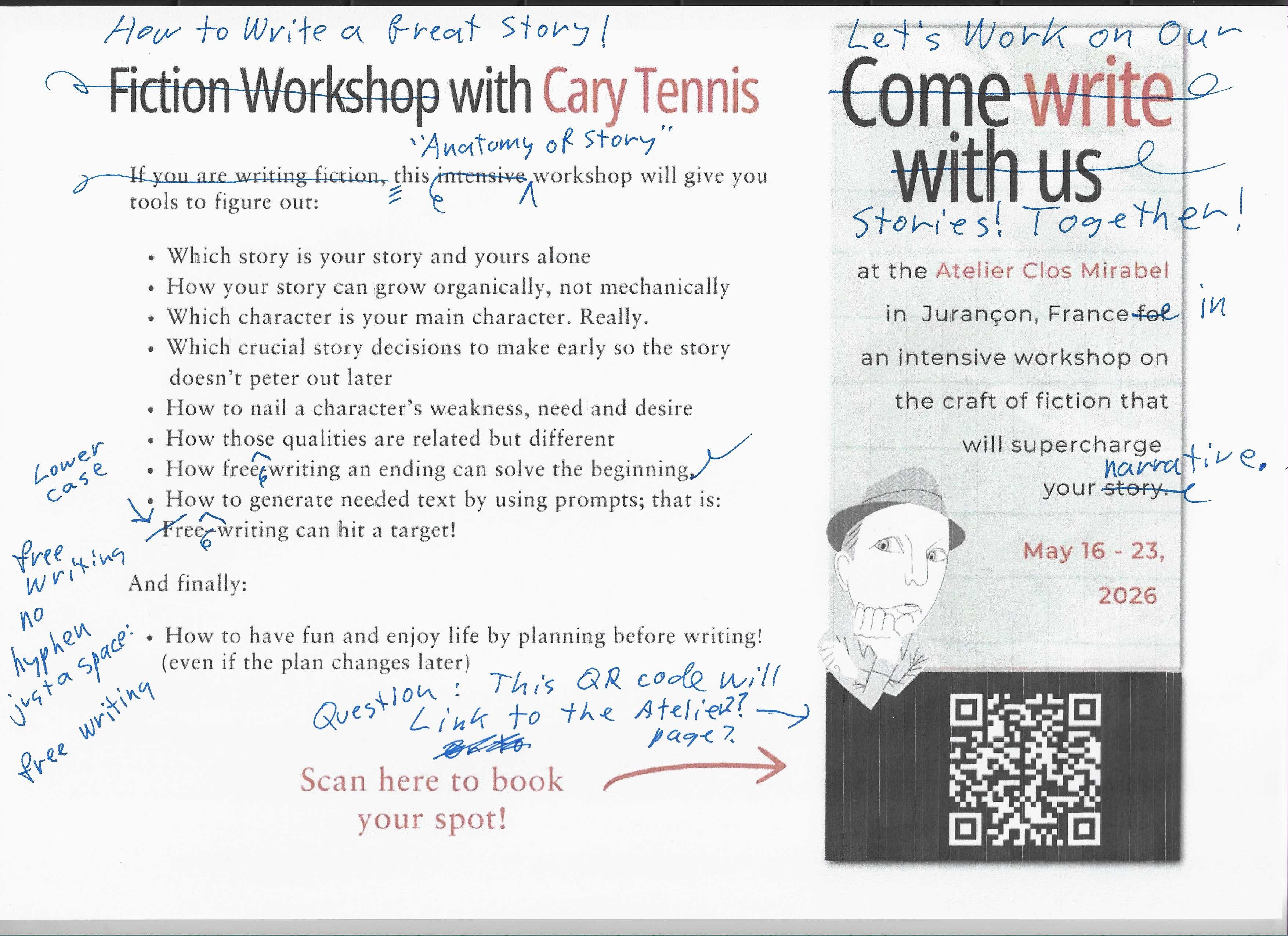
In The Anatomy of Story Truby says begin with a character’s weakness—not the character’s goal but what precedes it: some flaw in the character’s nature, of which he may be unaware, that has him in hell. The goal comes later. It arises out of that essential weakness.
In my little piece I posted last week, the the Twisted Romeo sounds like a bigtime jerk. I mean, duh. But to me he is lovable because he’s so transparently an asshole. He’s a soul in hell trying to laugh away his pain. His soul is on fire but he doesn’t even pause to slap at his own flames. It is unconfortable to be around such people. It’s maddening! Which is one reason maybe people heard one paragraph of this dude and said nah, there’s a new Heather Cox Richardson post on Substack, think I’ll relax with that.
So here is what I did: I did yoga. I meditated. Lying on my back then, iPhone in hand, words came to me! I spoke these words into the speech-recognition function of my Notes app.
Where that places me in history I wonder.
Your Honor, if it please the court, I offer into evidence this transcription (seriously, verbatim; it’s like you can look right inside my skull and see my little pea-size brain sputtering, turning over, trying to start):
In thinking about what the Twisted Romeo does next, I realize his main weakness is one of avoidance. So he will do everything he can to avoid her. If she won’t go away, he will turn off the stereo and sit silently in his room, hoping she goes away. He will come up with methods to try to determine if she is still out there. He might call a friend and ask him to come visit and see if she is out there and then have the friend report to him. He will try to see somehow if she is still out there. But she will wait ...
But then how will the story end? Still not sure about that. All I am sure about is that his driving ambition is to avoid consequence. So he will stay in that room as long as possible because she is consequences embodied. He assumes that she is the avenging angel of his misdeeds.
What this decision indicates is that while there are many possible actions he could take, there will be one that is a clear outgrowth of his nature. If his nature is not evident yet to the reader, this action will make it so. And if the reader has already sensed that this is his nature, it will reinforce that suspicion.
So the relevant insight from this is that in terms of a writerly practice, one has to sit and ask the question, What does he do next?, and wait for an answer before just scribbling on and on.
“He will have to wash somebody’s feet. Those feet will probably have toe fungus. They might belong to an old lady. They might belong to his mother.”
It’s best at this point to think about the whole rest of the story. Where is he going to end up? If he is going to change, and if that is what we are trying to portray, then what will that change be and how will it come about? For this change must originate in his own nature. So maybe he will try to stop avoiding things by attempting to face things. That seems like the most satisfying and paradoxical way to end the story. But I don't think he'll do well at it. Maybe he'll at least make a start. That will be the change: He will make a start.
How does one do that? Maybe he substitutes a higher kind of avoidance for the lower kind of avoidance. Maybe he finds someone else who will avoid things for him somehow! Maybe he throws himself into life using the same phenomenal will power that has powered his life so far, to force himself into situations that he has to just endure. Maybe life becomes a kind of psychic workout where he grows his acceptance muscle.
What else happens outside his apartment? Maybe he orders pizza and the pizza delivery man tries to get the pizza through the door, but the ex-girlfriend prevents it so that she is trying to starve him out. Maybe he calls the police and they come and she explains what’s going on and they just laugh and tell him to go fuck himself. Maybe the police officer who arrives is a woman, who totally gets the situation and sides with the other woman.
Maybe there is a window and a balcony and he opens the window and climbs out on the balcony but then he just can’t decide what to do. It’s too dangerous to jump. And after all, he’s not a crazy guy! Maybe when he is out on the balcony someone he owes money to passes by and yells up at him and he scrambles back in the window.
What I am trying to do is be a guinea pig for this method in order to open the window to others who might see that this is possible. That this is a possible way to move forward with a story: by thinking about the character and what he’s like or she is like and what That One Driving Force is. What John Truby would probably call that characters weakness. Which it is. This character‘s weakness is his fear and selfishness.
A related principle here [I’m telling myself!] is that you should never give the character what he wants right away. Thwart him at every turn if you can. Make his life worse if you can. Put all the obstacles in front of him. Do not give in too easily. Make him work for it.
As far as his journey, if he is on a journey, that journey might constitute several chapters in which he is trying to reach home--a symbolic home. He may have strayed far from "home," which is part of his problem. So the narrative might be an odyssey narrative. And his change, where his character-building can occur, is along the road.
If it was a novel, he would be pursued by the many people to whom he owes amends. He would meet them along the way. They would pursue him. In each case, it would be a beautiful but antagonistic confrontation, with humor and forgiveness. And it would take him a long, long time to get it: that he is operating in a spiritual universe. And that he is not the center of it.
He will have to wash somebody’s feet. Those feet will probably have toe fungus. They might belong to an old lady. They might belong to his mother.
In case you would now like to weight in, here’s the link again: Twisted Romeo “What-Happens-Next Narrative Fiction Challenge”.
Cheers
Cary T.
Good job starting to read craft books like Truby’s. Passion is important. Storycraft is next. We practice craft so people finish reading our stories. We also practice it so we can finish writing them.
If he escapes via a balcony, does he have to go down? Can he get to the nextdoor neighbor's balcony? Who lives there? Will the balcony become his only means of entry/egress to/from his apartment?